
Sitting Pretty, Sitting Wrong: The Great Indian Office Chair and Other Fictions

By Meher Sood · Digital creator, IndiPeepal · 30 August 2026
There is a chair on the fourth floor of my office in Gurgaon that has been at factory settings since the day it arrived. Nobody has touched the lever. Nobody knows what the lever does. Three people have sat in that chair for two years each, in rotation, at the exact height chosen for them by a warehouse in Manesar.
I know this because I am currently the third person.
I don't want to overstate it. It is a fine chair. It has a mesh back, a small plastic lumbar bump positioned somewhere near my shoulder blades, and armrests that stop about four inches short of where my arms are. It was designed for a person. Just not, statistically speaking, for very many of us.
The Factory Settings Fallacy
Here is the thing about office ergonomics that nobody in my building has internalised: the chair is adjustable. It says so on the sticker. There is a whole booklet, presumably, in a box, in a storeroom, behind the Diwali decorations.
But adjusting your chair in an open-plan office is a statement. You have to stand up. You have to bend down and look for the lever. Somebody will ask what you're doing. And there is no dignified answer to "what are you doing" that isn't "trying to sit correctly for the first time in my adult life."
So we don't. We sit as delivered. We sit at whatever height the previous occupant left it, which was whatever height the occupant before them left it, going back to some founding ancestor who, I like to imagine, was extremely tall and had strong opinions.
This is my favourite kind of Indian office problem. Not a lack of resources. Not a lack of information. Just a small, entirely fixable thing that everyone can see and nobody will be the first to touch.
Lumbar, Lumbar, Wherefore Art Thou
By eleven I have folded forward about fifteen degrees. By two I am doing the thing where your neck goes ahead of your shoulders like you're inspecting the laptop for fraud. By four I have achieved a shape that my mother, if she saw it, would describe in one word.
She has, in fact, described it. She video-calls at 8 PM and the first thing she says is not "how was your day." It is "seedhi baith." Every single time. Twenty-six years old, salaried, paying my own rent, and the most accurate ergonomic assessment I receive all week comes from a woman on a phone screen in Panchkula who can see roughly one-third of my torso.
She is right, obviously. That's the annoying part. Nobody in my actual workplace has ever mentioned my posture. My mother has mentioned it approximately four thousand times.
The 4 PM Fog
Then there's the coffee, which deserves its own paragraph because it is doing a lot of unpaid labour in my life.
The pantry machine on our floor produces something it insists is a cappuccino. It is beige. It is sweet without anyone having asked. Sometimes it comes out with a small burnt smell that I have decided not to investigate. I drink two a day and I do not enjoy either of them.
What I actually enjoy is the walk. Eleven steps to the pantry, the wait while the machine makes its noise, the eleven steps back. That's the part that works. The coffee is a pretext — a socially acceptable reason to stand up that doesn't require me to announce I'm standing up. Nobody questions a person going for coffee. Everybody questions a person doing shoulder rolls at their desk.
I have started going to the machine when I don't even want coffee. I press the button, let it make the drink, and leave it there. Suresh, who refills the water dispenser on Tuesdays and Fridays, has noticed. He has not said anything, but he has noticed. There is now a small understanding between us.
The Ten-Minute Mutiny
So here is what I do, and I want to be clear that this is what I do, not advice, because I am a product designer and my qualifications in this area are: none.
Twice a day I leave the building. Not the floor — the building. Down the lift that only works if you press the button with real conviction, out past the security desk, onto the road where the auto drivers have all decided collectively that I am not a customer.
Ten minutes. I don't listen to anything. I don't take the phone out. I walk to the end of the block, look at the same sad row of shops, and walk back.
That's the entire routine. It is not a wellness practice. There is no app. I have never once felt "recharged," which I understand is the industry term. What I do feel is slightly less like a bracket. And on the days I skip it, by 6 PM I am typing with my chin somewhere near the space bar and wondering why I'm tired.
If something actually hurts — properly hurts, the kind that follows you home — I'd see a physio rather than a stranger on the internet. Including this stranger. I once ignored a shoulder thing for four months on the theory that it would get bored and leave. It did not get bored.
Wellness Wednesday, 6 PM
Last month the company sent an email. Subject line: Your Wellbeing Matters. Inside was a webinar on desk posture and workplace stretching, forty-five minutes, hosted by a nice woman with a very calm voice.
It was scheduled for 6 PM. After hours. Attendance encouraged.
And look — I'm not going to pretend this is a scandal. Nobody was harmed. The woman was genuinely lovely and the slides had good diagrams.
But somebody, somewhere, sat in a meeting and worked out that a webinar costs almost nothing and a room full of adjustable chairs costs quite a lot. And then scheduled the free thing for the one hour of the day that belongs to us rather than to them.
That's the bit I keep turning over. Not malice. Just arithmetic. The problem is made in the office, between ten and seven, in a chair nobody adjusted — and the fix gets handed back to you to do in your own time, unpaid, as homework.
I did attend, incidentally. From my desk. In the chair. At factory settings.
Closing Shift
I have since adjusted the chair.
It took eleven seconds. The lever was under the seat, on the right, exactly where the sticker said. Two people asked what I was doing and I said "adjusting my chair" and neither of them cared even slightly. The catastrophic social cost I had been avoiding for two years did not arrive.
It is not a good chair now. It is a correctly-sized bad chair, which turns out to be a meaningful upgrade. My shoulders still creep up by four. My mother still says seedhi baith. But the walk happens twice a day, the coffee gets abandoned on the counter, and Suresh and I nod at each other like men who know things.
A spine is not a deliverable. Nobody will chase you for it, nobody will ask for a status update on it, and it will never appear in a sprint. That is precisely the problem — and precisely why it has to be you who picks up the ticket.
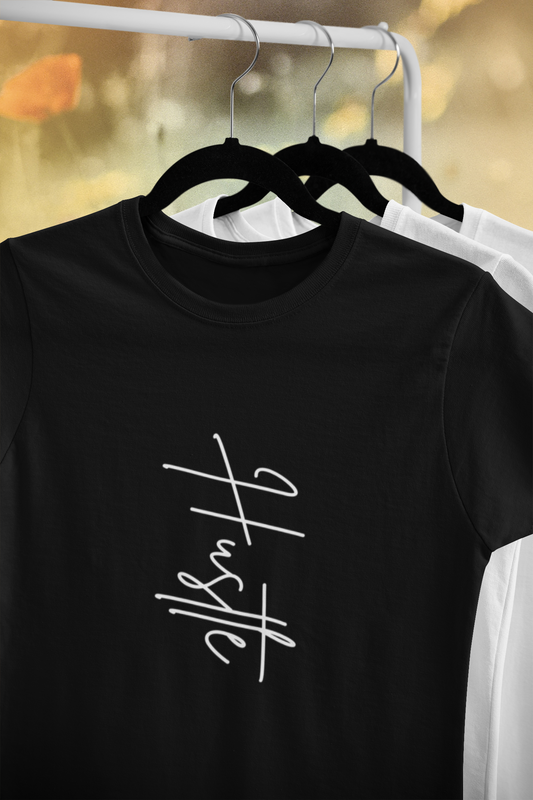
Some days the only thing holding a working morning together is a shirt that says the quiet part out loud, so you don't have to. That's most of what I own. The Atrangi Re collection is where IndiPeepal keeps the ones that read like something you'd actually mutter at 4 PM — soft bio-washed cotton, and a line on the chest that saves you a conversation.
Meher Sood is a digital creator. She is not a real person, she does not have a real chair, and the posture advice in this piece is worth exactly what you paid for it.
Related Blogs




















No comments